Project Sea Dragon
Seafarms Group Limited proposed to develop a substantive aquaculture project located on the Legune coastal floodplain within the extreme north-west corner of the Northern Territory.

Client: Turner Family Foundation
Project: Conservation monitoring
Timeline: 2025- present
The Turner Family Foundation (TFF) manages a portfolio of nature refuges, farming properties, and ecotourism ventures across south-east Queensland and northern New South Wales, with a strong focus on conservation, land restoration, and building resilient ecosystems for native wildlife. Among their holdings are Old Hidden Vale (OHV) — a 4,500-hectare working cattle station and nature refuge in the Little Liverpool Range — and Spicers Peak Station (SPS) — a 3,000-hectare property on the Scenic Rim adjoining World Heritage–listed Main Range National Park.
TFF had previously invested in a koala collaring program which, whilst insightful, was resource-intensive and limited in its ability to deliver site-wide population data at the scale needed to inform land management decisions. They approached Austecology to design and implement a cost-effective alternative. The result was a monitoring framework that could be repeated annually to track population density, health and reproductive success, and provide an objective, measurable understanding of how land management practices were impacting koala populations.
As a secondary objective, TFF were interested in better understanding the value of their properties for other threatened species that might be present but had never been formally surveyed for.
Both survey programs delivered valuable outcomes, and the following focuses on the Spicers Peak Station component as a showcase of what targeted, technology-driven survey design can achieve on a conservation budget.
Austecology determined that a thermal drone approach would provide the most cost-effective and comprehensive means of assessing koala populations at a landscape scale. Over 715 kilometres of aerial transects were flown across SPS during the early morning hours when thermal contrast between animals and the surrounding vegetation is at its greatest, allowing individual koalas to be detected by their body heat.
Each animal’s location was recorded alongside visual assessment with the drone’s zoom camera to determine sex, the presence of joeys, and any overt signs of illness. This data feeds into a measurable framework built around three key indicators: spatial use and population distribution, reproductive success, and the rate of disease — allowing TFF to track trends across future monitoring events and direct resources where they are needed most.
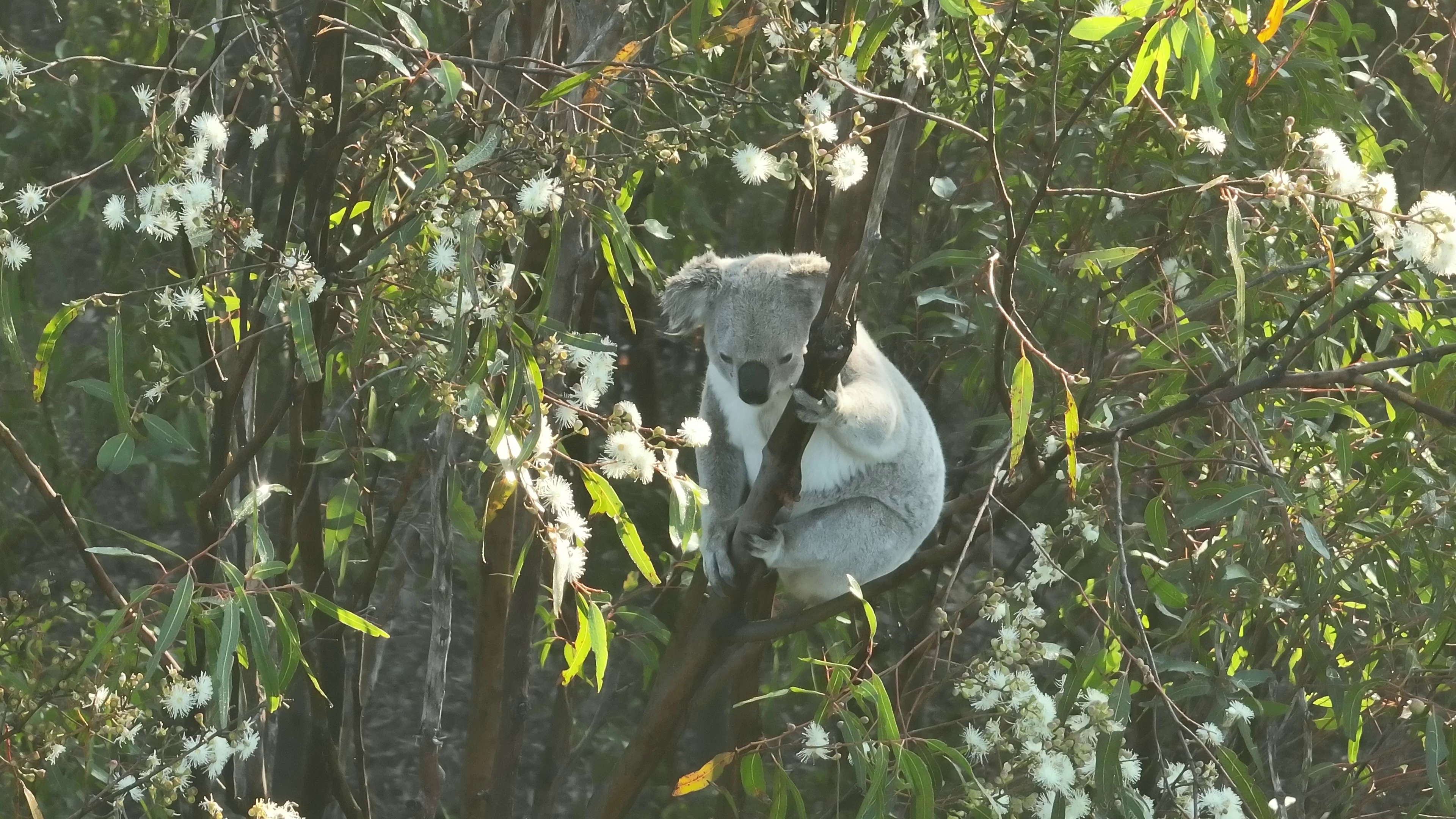
The SPS survey revealed a high-density koala population distributed across a majority of the site.
These results gave TFF a clear picture of where their koala population is thriving, where intervention is needed, and which corridors are critical to protect. It’s the kind of practical, management-ready data that turns monitoring into meaningful action.
Alongside the core drone program, habitat assessments were
conducted across SPS during the day to evaluate the site’s potential for other
threatened species. Over the course of just 10 days, these assessments led to
the confirmed presence of four additional threatened species.
Diurnal habitat assessments identified characteristic ‘orts’ — the distinctively chewed remnants of sheoak (Allocasuarina) cones — beneath feeding trees, indicating active foraging on the site. A passive acoustic monitor (PAM) was deployed at the location, and subsequent semi-automated call analysis confirmed the species’ presence from their distinctive calls.
Habitat assessments also revealed distinctive feeding incisions carved into the trunks of eucalypts — a clear sign of yellow-bellied gliders feeding on sap. A PAM unit was deployed to capture nocturnal vocalisations, and semi-automated analysis confirmed their presence through their loud, distinctive shrieking calls.
The most significant discovery of the survey was the detection of the large-eared pied bat through ultrasonic call recording, with its distinctive echolocation signature identified during subsequent analysis. This species is listed as Endangered under both Commonwealth and state legislation, and is just the second record in the Main Range within the last 30 years — making confirmation of its presence at SPS an important threatened fauna result.
Grey-headed flying-foxes were also recorded at SPS during drone operations, adding a fifth threatened species to the property’s confirmed fauna.
Recognising evidence in the field and deploying passive technology to confirm it meant that multiple investigations could run in parallel without competing for time or resources. The result was a survey that delivered well beyond its original scope within the same field program, without expanding the field team or field time.
Working across 10 days with a thermal drone, passive acoustic monitors, and ultrasonic recording equipment, our team delivered a comprehensive koala population assessment across a 3,000-hectare property, established a repeatable monitoring framework with measurable health and population metrics, and confirmed the presence of five threatened species.
With a compact field program and the right mix of tools, we achieved property-scale koala monitoring while running targeted threatened species investigations in parallel.
For foundations, land trusts, and conservation organisations managing properties with limited budgets and a need for rigorous, defensible ecological data, this is the approach that makes the difference. Get in touch to discuss how a targeted survey program can reveal what’s on your property and help you manage it.
Species images: Yellow-bellied glider © Greg Tasney, CC BY-SA 4.0
Grey-headed flying-fox © Andrew Mercer, CC BY-SA 4.0
Large-eared pied bat © Doug Beckers, CC BY-SA 2.0

Seafarms Group Limited proposed to develop a substantive aquaculture project located on the Legune coastal floodplain within the extreme north-west corner of the Northern Territory.

The Coomera Connector (sometimes referred to as the Second M1), is a future state-controlled road extending some 45 kilometres from the northern Gold Coast to Loganholme.